AI Readiness Index · South Korea · Q2 2026

South Korea: AI readiness, Q2 2026

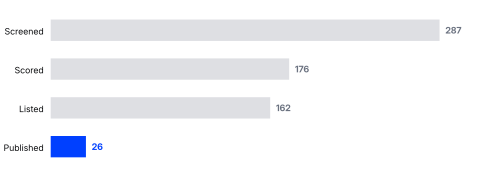
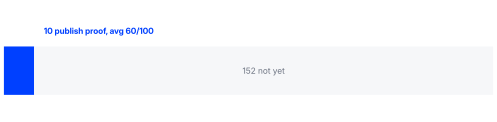
10 companies here publish proof of their AI capability. They average 60 of 100 on that signal. 26 of 162 scored companies are in the published APAC 1,000.

South Korea, in numbers

65Readiness score for South Korea. Range 57-73.
38.0Average visibility score across 162 scored companies. Public evidence only.
26Companies here that reach the published APAC top 1,000, of 162 scored.
The Q2 2026 measures for South Korea
MeasureValue
Screened this cycle287
Left too little public trail to assess111
Cleared the evidence gate and were scored176
Organisations counted in the market averages162 (14 duplicate rows for the same group counted once)
In the published APAC 1,00026
Domestic entities153
Readiness score65 of 100 (range 57-73)
Average visibility38.0 of 100
Evidence gradeB
Dossier20 pages, 4.4 MB

AI on the record

The conditions companies here operate under score 65, and what those companies publish scores 38.0. Of the two, the second is the one companies here control, and the quicker to change: 94% of the 162 companies with enough of a public trail to score publish no proof of capability at all.

Companies in South Korea talk about AI in public, and manufacturing carries the visible end of that record. The ten publishing proof of capability average 60 of 100.

Tier mix in South Korea
Exhibit 1. Tier mix in this market. Source: AIR APAC AI Readiness Index, Q2 2026.
Readiness against visibility in South Korea
Readiness against visibility for South Korea. Source: AIR APAC AI Readiness Index, Q2 2026.
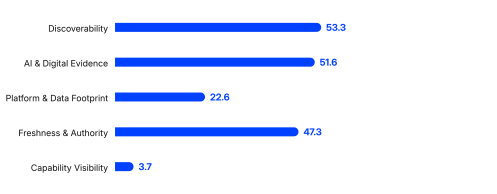
Average score by signal in South Korea
Exhibit 2. Average score by signal in this market. Source: AIR APAC AI Readiness Index, Q2 2026.
Visibility ladder in South Korea
The visibility ladder in South Korea. Source: AIR APAC AI Readiness Index, Q2 2026.

Invisible is not the same as absent

Buyers, investors and partners often treat a missing record as missing work. Most decisions about a company are shaped before anyone makes contact, based on what people can find. For most people, the public record is the only picture of a company they ever see. In South Korea, 111 of 287 companies screened leave too little public evidence to assess.

Capital and customers screen before they call

Investors, corporate buyers and procurement teams build a shortlist from public material long before a meeting exists. A company absent from that material is not rejected on the merits. It never reaches the shortlist.

Partners and talent read the same record

Prospective partners, joint-venture counterparties and senior candidates all check what an organisation says about its own AI work. Silence is read as inactivity, which is often wrong and rarely without cost.

AI assistants now answer the question first

When someone asks an AI system what a company is doing with AI, the answer is assembled from public sources. A company that publishes nothing lets other sources describe it.

“Most companies we look at are doing more with AI than their customers, investors and partners can see. The work is real, the evidence of it is thin, and people decide on the evidence.”

AIR APAC, Q2 2026 market reading

26Companies here reach the published APAC top 1,000.
40%Of 162 scored rest on grade A or B evidence.

What to do with a visibility score

A visibility score is something a company here can move, because every signal behind it is something it already controls. Three steps separate it from a record that shows what it is actually doing.

Start with the company's own row

Every scored company in South Korea appears in the dataset with its five signal scores and an evidence grade. A grade C or D row is usually a company that has not said much, not a company that has not done much.

Then measure what this cannot see

This index reads the outside only. Leadership alignment, governance, data quality and workforce capability are invisible to it by design, and that is where the real answer sits.

Correct the record on purpose

Proof of capability is the region's weakest signal, because companies announce intent faster than they show work. Job posts, named leads and dated case studies move the score honestly.

None of this requires a new AI programme. It requires publishing the one that already exists.

Evidence quality in South Korea
Evidence quality behind the scores in South Korea. Source: AIR APAC AI Readiness Index, Q2 2026.
Proof concentration in South Korea
How concentrated published proof is in South Korea. Source: AIR APAC AI Readiness Index, Q2 2026.

South Korea's strongest and weakest public signals

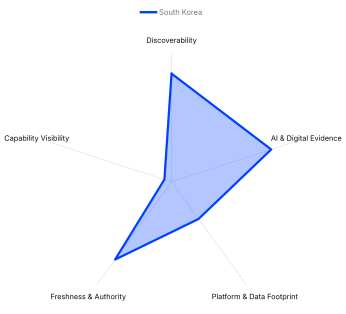
The five signals use different scales, so the longest bar shows how the Index works more than how South Korea performs. Read against its own other four signals, South Korea is relatively strongest on AI and digital evidence and weakest on discoverability. That weakest signal is the clearest place to start.

10 companies in South Korea publish evidence of AI capability, with an average of 60 of 100 on this signal. Where this evidence exists, it lifts the score. 94 percent of scored companies have not published it yet, against 83 percent across the region.

Work published only in languages other than English is understated here, not absent.

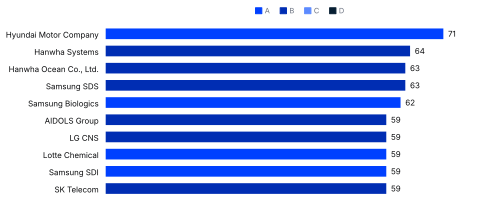
Most visible organisations in South Korea
The most visible organisations in South Korea. Source: AIR APAC AI Readiness Index, Q2 2026.
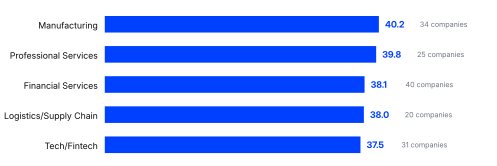
Sector strengths in South Korea
Sector strengths in South Korea. Source: AIR APAC AI Readiness Index, Q2 2026.
Signal fingerprint for South Korea
The signal fingerprint for South Korea. Source: AIR APAC AI Readiness Index, Q2 2026.
Four public-signal measures for South Korea, Q2 2026
SignalScore
Average visibility across the market38.0
Sector-stratified signal37.5
Supplier readiness signal39.0
Domestic adopter signal39.3

How this market reads against the published benchmarks

The country context blocks come from other publishers with other methods. They are shown beside the AIR APAC reading, never merged with it.

Country context for South Korea, with each source named
SourceValueWhat it measures
Oxford Insights Government AI Readiness Index 202479.98Country level, government readiness
IMF Artificial Intelligence Preparedness Index 202372.66Country level, economy-wide preparedness
Salesforce and Access Partnership, Business AI Readiness42.7Business AI readiness, from statistical indicators. 12 markets, 0 to 100 scale.
AIR APAC public-signal visibility38.0Outside-in reading of the organisations in this market

Benchmark years: 2023 and 2024. This market has both the economy-wide and the business benchmark.

Four tiers, and where companies in South Korea sit

A tier is a position in the published regional order, not a grade anyone awards. It says how much of a company's AI work a buyer or an investor can verify, and nothing at all about whether that work is any good.

Tiers in South Korea, Q2 2026
RungLabelOrganisations hereRegional orderWhat it means
Tier 1Proven1Region order 1-100Publishing enough, recently enough, and across enough of the five signals that the public record alone establishes an AI position.
Tier 2Building11Region order 101-400A consistent public trail, usually strong on two or three signals and thin on evidence of hiring.
Tier 3Findable14Region order 401-1,000Credibly active and possible to verify, but sparse enough that it takes a deliberate search to find.
Tier 4Scored, not listed136Beyond the published 1,000Clears the evidence threshold but does not reach the published list. Real companies, scored and unlisted, and the largest group in almost every market.

1 of the 162 companies in South Korea that clear the threshold reach tier 1, and 136 are scored but not listed, 84% of those scored.

Moving up a tier is a disclosure decision, not a technology one, because every signal this index reads is something a company already controls.

40%Of scored companies rest on grade A or B evidence.
42%Of 162 listed rest on the weakest evidence grade. Region: 22%.
38.7%Of 287 screened leave too little to score.

The most visible organisations in South Korea

From the published APAC 1,000, at the same scores and the same evidence grades as the regional table. Each one has its own page. Shown in published order. No position can be bought.

The twenty most visible organisations in South Korea, Q2 2026
OrderOrganisationSectorTierScoreEvidence
21Hyundai Motor CompanyManufacturingPacesetter71.0A
122Hanwha SystemsProfessional ServicesMomentum64.0B
143Hanwha Ocean Co., Ltd.ManufacturingMomentum63.0B
150Samsung SDSLogistics/Supply ChainMomentum63.0B
200Samsung BiologicsManufacturingMomentum62.0A
279AIDOLS GroupProfessional ServicesMomentum59.0B
308LG CNSLogistics/Supply ChainMomentum59.0B
311Lotte ChemicalManufacturingMomentum59.0A
326Samsung SDIManufacturingMomentum59.0A
332SK TelecomTech/FintechMomentum59.0B
340Woori BankFinancial ServicesMomentum59.0B
356Kiwoom SecuritiesFinancial ServicesMomentum58.0A
470KB SecuritiesFinancial ServicesEmerging56.0B
527Kakao Pay Corp.Financial ServicesEmerging55.0B
528LG ElectronicsManufacturingEmerging55.0A
584Olive YoungRetail/E-commerceEmerging54.0C
675LunitProfessional ServicesEmerging53.0B
703Samsung ElectronicsTech/FintechEmerging53.0B
709SK C&CTech/FintechEmerging53.0B
898Hyundai AutoEverProfessional ServicesEmerging50.0B

What this report does not claim

Known blind spots in this market

Two known gaps apply to South Korea this cycle. Evidence comes from English-language search only. The country context also uses two of the three planned source types.

A high score means published, not proven

A high visibility score means a company publishes a lot that can be found about its AI work. It does not mean the work is good, in production, or making money. A company here running serious AI quietly will score low here, and it should: this index reads the public record and nothing else.

What would change these numbers

Three improvements are planned and documented in the method: fuller source coverage for each market, a tested coverage weighting, and merging companies that use several websites. The next edition, the APAC 5000, is published once a year.

Every limitation the Index carries is on the limitations page, and the method itself is on the methodology page.

Download the dossier and the data

The dossier

AI Readiness Index, Q2 2026 results, South Korea

PDF, 20 pages, 4.4 MB. Open, ungated, no form. In the dossier PDF, Emerging refers to the group labelled Scored, not listed on this page.

The data behind it

The published 1,000, as a table

CSV, 1,000 rows. Open, ungated, no form. The first column is the order each organisation holds in the published list for this edition. No position is awarded and none can be bought.

A correction

Suggest a correction

If a row here misreads your organisation, the route to correct it is the contact page.